Metadata Composer overview and model
Metadata Composer adds real-world context to receiver-log detections: where stations were, which devices were deployed, which animals carried tags, and when those relationships applied. Use this page to choose a task and understand how the records fit together.
Start with a task
Open the intended project, choose Metadata Composer, and wait for Reading metadata... to clear.
| Goal | Start here | You are done when |
|---|---|---|
| Create a Device and transmitter ID | Create a device and transmitter ID | The Device and transmitter ID are saved without duplicate-identity issues. |
| Describe a receiver Station | Describe a receiver station | The Station has the intended period, usable position, and receiver attachment. |
| Describe a tracked Animal | Describe a tracked animal | The Animal has the intended tracking period and Device attachment. |
| Build Devices from receiver-log evidence | Build Devices from the current Dataset | The preview has been applied or intentionally left unchanged, and conflicts are visible for repair. |
| Import a table or tag sheet | Import a station or device table or Import a tag sheet | The import summary matches the intended result and identity issues are resolved. |
| Fix missing Data Explorer rows | Repair a metadata-backed grouping | The required Device, period, attachment, and identity relationships resolve without ambiguity. |
| Enter or repair dates and coordinates | Enter or repair dates and coordinates | The entered text remains reviewable and ReceiverLogs can interpret it. |
Metadata workspace
Metadata Composer has three workbenches:
- Stations describe receiver locations, moorings, vessels, gliders, and other infrastructure.
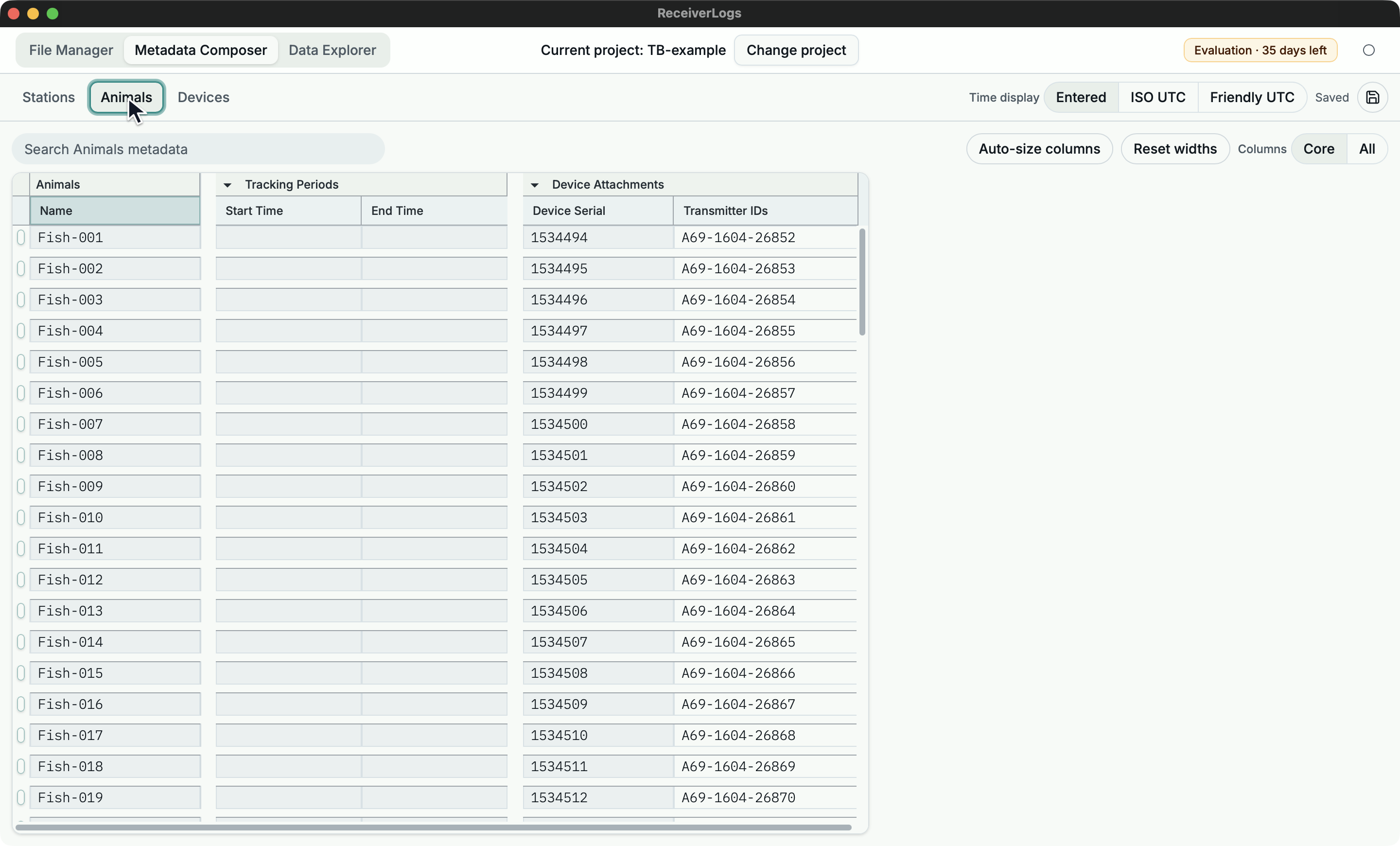
- Animals describe tracked subjects or objects.
- Devices describe physical receivers, transmitter tags, stationary tags, and sensors.
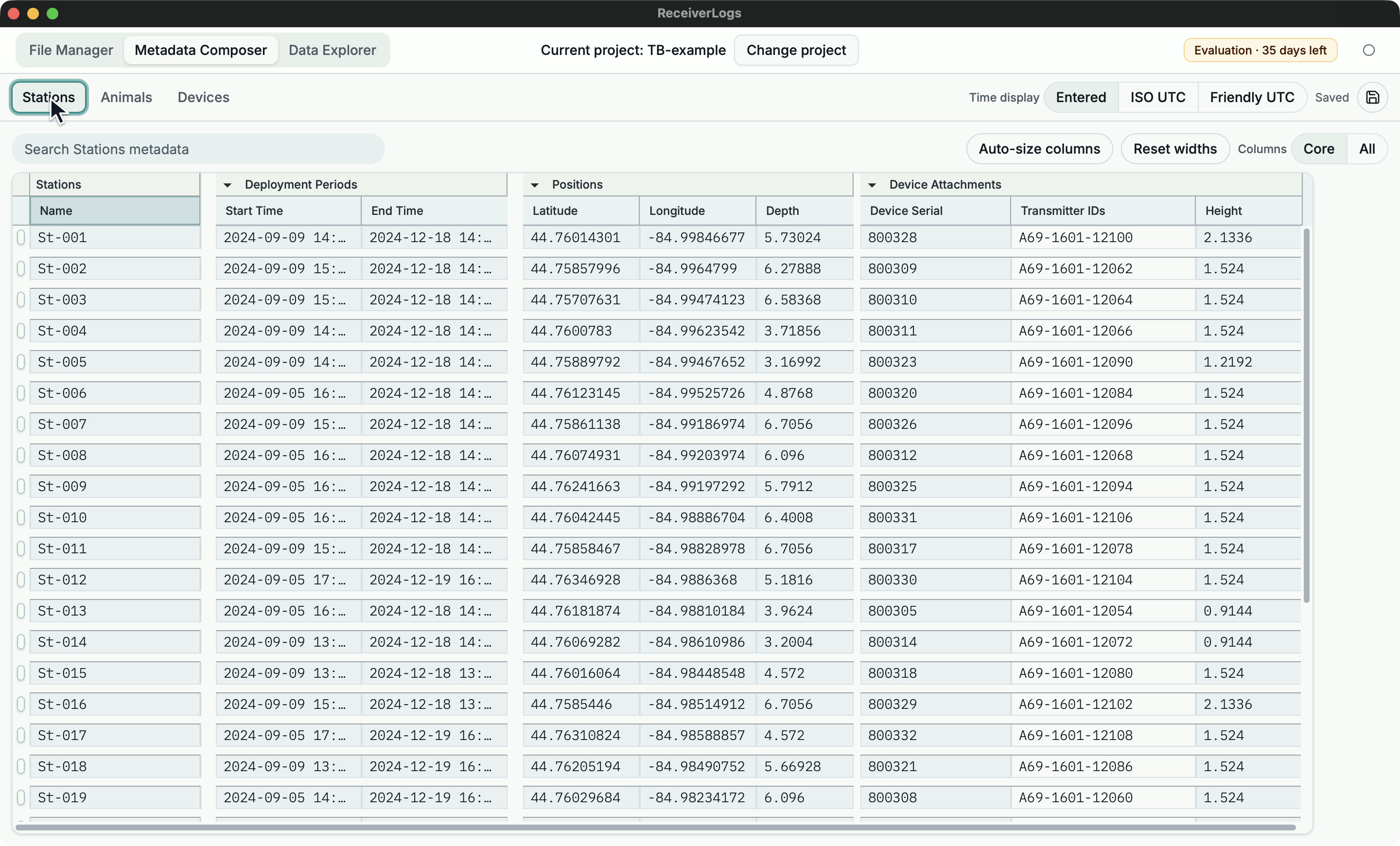
The active workbench lasts for the current Metadata Composer session. Project-specific table choices, such as expanded column groups and time display, remain separate for each project during that session.
Metadata Composer allows incomplete work to be saved. Validation identifies relationships or values that need repair; it does not turn every row into a blocking form.
The basic mental model
- Devices are hardware. A transmitting Device can have one or more transmitter IDs.
- Stations and Animals are hosts. They describe the infrastructure or subject associated with a Device.
- Periods say when a host is active. Stations have deployment periods; Animals have tracking periods.
- Positions and attachments belong to a period. They say where a Station was and which Device was attached during all or part of that period.
Station
  -> Deployment Period
       -> Position
       -> Device Attachment

Animal
  -> Tracking Period
       -> Device Attachment

Device
  -> Transmitter ID
A blank child Start Time or End Time uses the corresponding boundary from its parent period. Interval boundaries and examples are documented in Metadata values, validation, and recovery.
Receiver-side context comes from the receiver Device's Station attachment. Transmitter-side context comes from the detected transmitter ID, its Device, and the Station or Animal attachment active at the detection time.
If a required relationship is missing, invalid, duplicated, or ambiguous, Data Explorer leaves that detection out of the corresponding metadata-backed grouping. Raw receiver and transmitter-ID groupings remain available for comparison.
Stations
Stations use this hierarchy:
Station
  -> Deployment Period
       -> Position
       -> Device Attachment
A deployment period describes when the Station or platform was active. Position rows describe where it was. Device Attachment rows identify the receiver or other hardware attached during that period.
Latitude and Longitude locate the Station; Depth is positive-down metres. Station attachment Height is a signed value in metres.
Animals
Animals use this hierarchy:
Animal
  -> Tracking Period
       -> Device Attachment
A tracking period describes when the Animal is intended to be tracked. Its Device attachment may cover the whole period or a narrower interval. Animals do not have Position rows.
Devices
Devices use this hierarchy:
Device
  -> Transmitter ID
The Device serial is used by Station and Animal attachments. Transmitter IDs connect detection records to the Device.
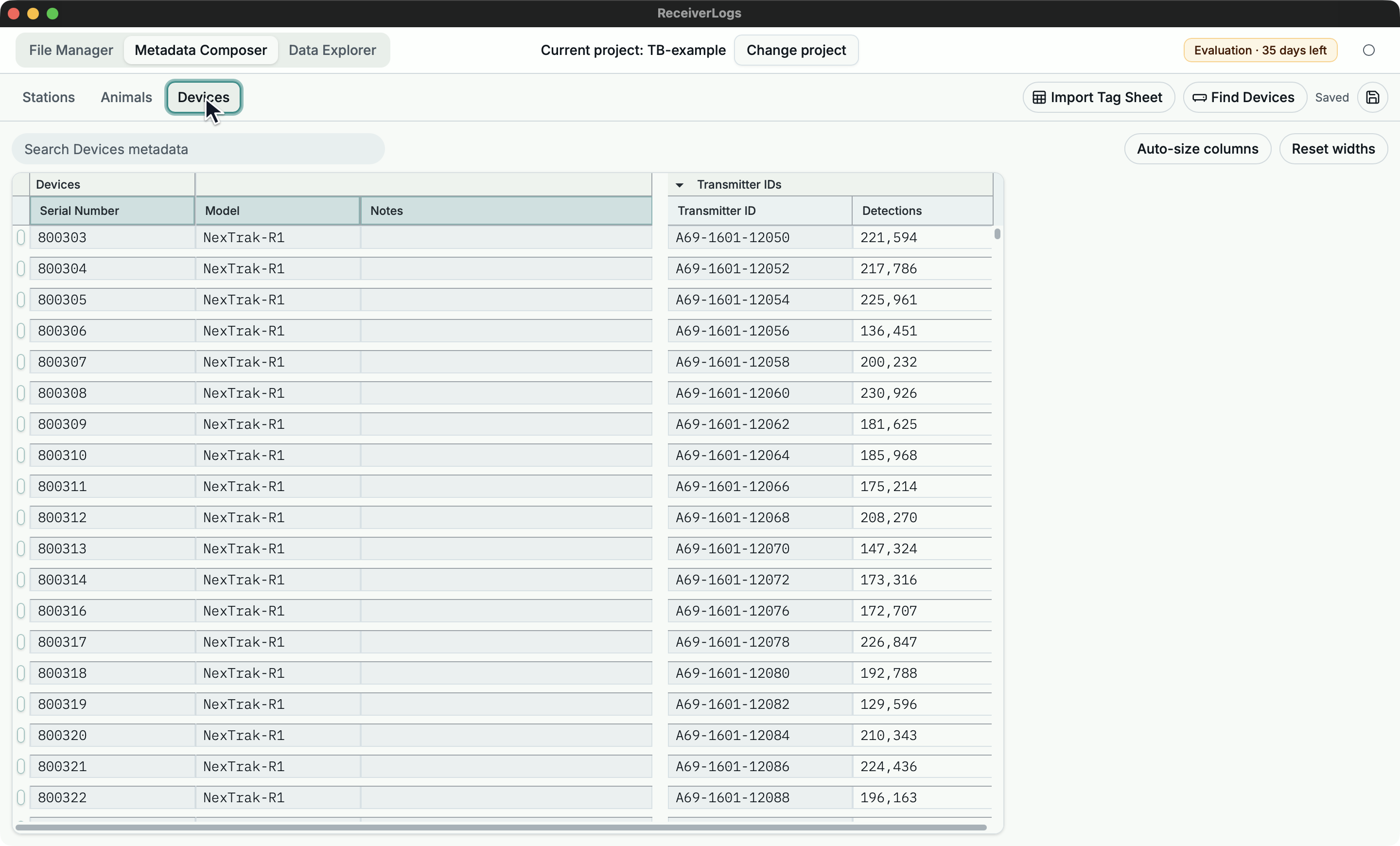
The Detections value is read-only evidence from the current Dataset. It is not metadata you can edit or paste back into the table.
More help
- Create and edit metadata
- Import and discover metadata
- Metadata tables and record operations
- Metadata values, validation, and recovery
Limitations
- Metadata-backed Data Explorer groupings currently cover receiver Station, transmitter serial, transmitter Station, and Animal relationships.
- Metadata is not yet a general filter system for every detection field.
- ReceiverLogs does not calculate an attached Device's exact position from a host position and local attachment offsets.
- Use the supported table and import workflows; there is no general metadata workbook export/import format.